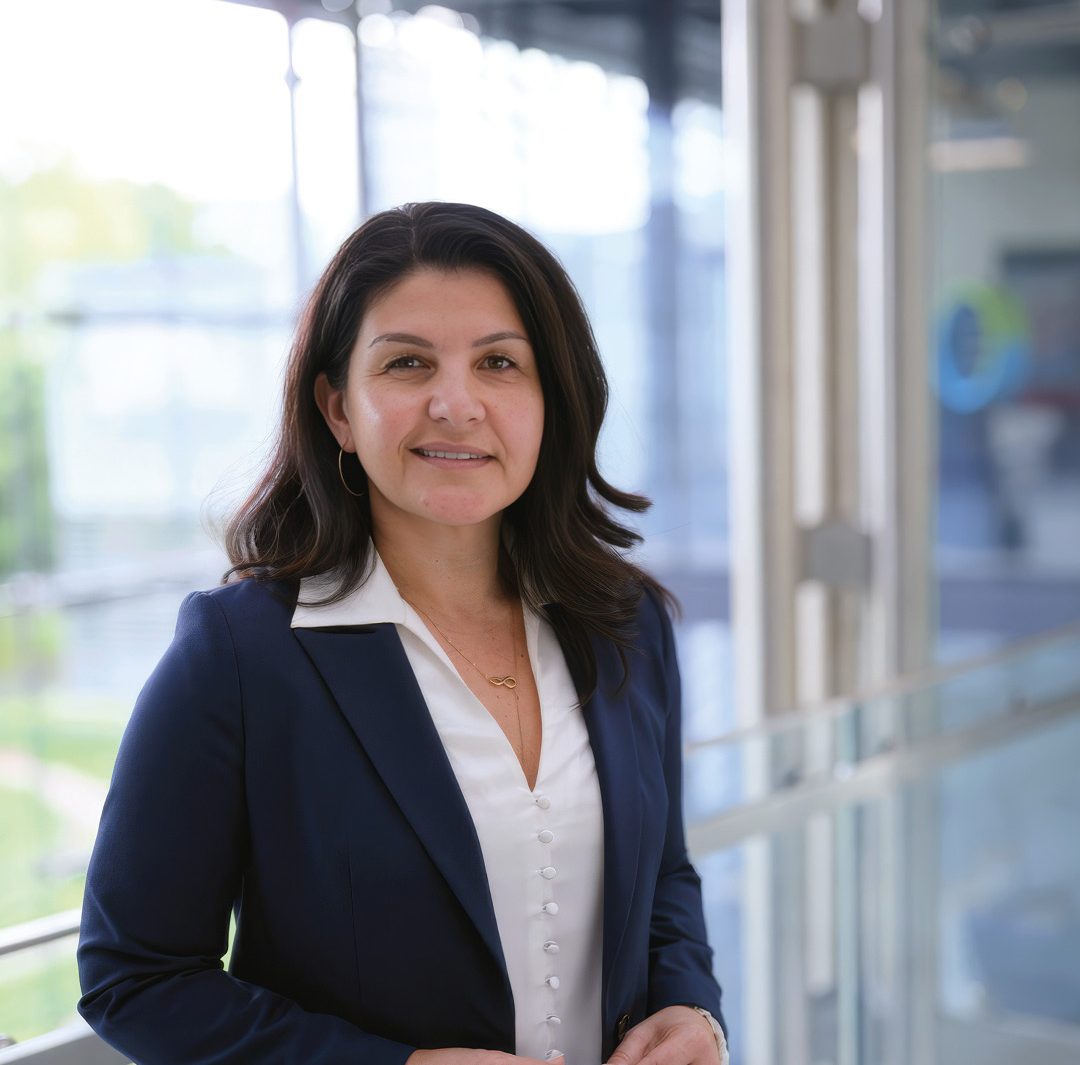

Cristina Nitulescu has always been drawn to big, complicated problems. Today, as Chief Information Officer (CIO) for Bayer Consumer Health, she is reshaping how the division uses technology and science-based self-care to reach billions of people and help them build healthier futures.
“It’s not an IT transformation,” Cristina says. “It’s a business transformation – and AI is redefining how work gets done, how decisions happen, and how Bayer Consumer Health scales globally.”
A platform-centric foundation
When Cristina joined Bayer four years ago, she stepped into a division that leaned heavily on external partners and struggled with overlapping systems, which created significant complexity. Her mandate was clear: shift from system- and application-centric thinking to product-centricity and get ready for a major SAP S/4HANA transformation. “We had to modernize our platforms because we relied almost entirely on external partners. That meant we weren’t steering our own technical future.”
Cristina and her team first mapped the Consumer Health technology estate, deciding which systems to retire, modify, or merge, and simplify wherever possible before the SAP overhaul began. Along the way, they rebuilt critical capabilities in-house, so the division could own more of its future rather than depending on external providers.
“That work led to a platform-based structure,” she continues. “Empowered leaders now run end-to-end technology domains, and full-stack engineering teams serve the business directly.” This step was critical, but it was only the beginning. “Today, we’re moving beyond product-centricity, building modular, composable, and increasingly headless platforms that we can orchestrate dynamically.” Cristina oversees these platforms across digital hubs in Poland and India, with teams in the US, Germany, Switzerland, and beyond.
One integrated transformation
Around the time Cristina stepped into the CIO role, Bayer launched Dynamic Shared Ownership (DSO), a company-wide operating model designed to reduce hierarchy, speed innovation, and empower smaller, accountable teams. Almost simultaneously, generative AI exploded into public consciousness, bringing new possibilities and added pressure to rethink long-standing architectural patterns.
“Cristina has adeptly harnessed technology, transforming it into a force for good that empowers billions of consumers to lead healthier lives every day. Beyond efficiency, she has effectively wielded technology as a backbone to scale trust, access, and better health outcomes. Cristina has been a great collaborator as we jointly pursue our vision of applying science to save lives”
.Vikas Jain, Head-Life Sciences, Tata Consultancy Services.
“Sometimes it feels like we’re part of several transformations at once,” Cristina observes. “In reality, we’re converging on one integrated transformation where DSO, AI, and architecture evolution all reinforce each other.”
“On the technology side, we’re breaking up traditional systems into smaller, reusable services that we can compose dynamically. Specialized AI agents increasingly orchestrate these components. Teams now ask if every process actually needs a classic user interface, or if we can expose capabilities headlessly and use agents, APIs, or conversational interfaces right inside our collaboration tools. On the organizational side, we align DSO teams to these domains so cross-functional groups own outcomes from start to finish.” The shared goal is to bring Bayer’s scientific rigor together with the speed and scale of digital-native tech companies.
Making AI a leadership priority
From the beginning, Cristina has challenged the idea that AI is just another tool. Over the past year and a half, she led the Consumer Health leadership team through an immersion program. She walked the team through the technology landscape, industry shifts, and Bayer’s biggest opportunities. “This isn’t me working in a corner and handing you another tool. We can’t sit on the sidelines. This is about thinking differently.”

As concepts such as agents and agentic systems entered the conversation, Cristina and her team focused on building basic literacy: what an agent is, what actually sits behind an AI solution, and what it takes to scale beyond impressive demos. That work has expanded from the C-suite into the wider organization as Consumer Health moves from isolated pilots toward systematic, platform-enabled AI adoption embedded directly into business workflows.
To keep that momentum going, Consumer Health set up an AI Catalyst Team, a cross-functional group from across the division. “This team surfaces promising ideas and links grassroots experimentation with enterprise platforms, making sure AI becomes part of real business processes instead of a side project,” she adds. The team also sets guardrails, standards, and governance, so AI scales responsibly.
Agents and the next generation
Cristina believes the biggest shift isn’t just about automating tasks – it’s about reimagining what AI makes possible for the whole organization. “For me, the interesting question is what happens if we assume agents can do much of the work. If they can deliver speed and scale almost instantly, how do we redesign domains that used to be sequential because of human limitations?” she wonders.
This perspective reinforces the shift toward headless architectures, where capabilities are no longer tied to applications, but can be invoked dynamically by AI agents across workflows.
That idea drives her to examine the future IT workforce. She leads a working group focused on what skills will matter in an agentic era. This is especially important for experienced engineers who have spent decades building and operating systems in more traditional ways.
“Adjusting hasn’t always been easy.” Early on, some experienced technologists were skeptical. But when sandbox environments and safe spaces for experimentation opened up, many of those same engineers and business colleagues began tinkering themselves. “They stepped up as champions.”
At a company known for deep scientific expertise, that combination of human knowledge and AI capability is especially powerful.By combining Bayer’s domain expertise with AI, teams can build intelligent systems that go beyond automation, acting as collaborators, advisors, and accelerators.
The ‘Road to Billions’
After spending much of her early career in medtech, Cristina found herself drawn to the fast-changing intersection of consumer and health, where engagement, experience, and scale are critical. “These organizations are, at their core, marketing companies. The brands are key assets, and channels like social media and influencer partnerships are essential to how they reach people.”
Consumer Health’s ‘Road to Billions’ strategy, which brings self-care products to people at global scale, resonates with her personally. She sees AI helping the division build brands that connect better and respond faster, enabling targeted campaigns, quicker content creation, and deeper engagement, while preserving the scientific foundation behind Bayer’s products. Modular, API-driven, and increasingly headless platforms power it all, letting teams reuse and scale capabilities globally with minimal friction.
“The most compelling AI use cases are not about shaving minutes off tasks, but about changing how Consumer Health listens to, learns from, and serves consumers on a global scale.”
Leading by multiplying
Cristina may be deeply technical, but she credits her career growth to a people-first philosophy. “I think my move into the C-suite reflects my focus on people,” she reflects. Early in her career, she measured her value by the platforms she built and the problems she solved herself.
That changed when she moved into leadership roles and, around the same time, became a parent. “It clicked for me that I could multiply my impact,” she remembers.
Since then, she’s taken pride in helping people identify their strengths, develop them, and find roles where those strengths matter most. She brings new opportunities to team members and has kept in touch with interns from more than 20 years ago. In an era of rapid technology change, where AI and new architectures continuously redefine roles and capabilities, “Leaders must be clear about expectations, generous with opportunities, and committed to developing people as much as platforms.”
TCS blends science, technology, and human ingenuity to advance the perpetually adaptive lab-to-life value chain. From AI-led drug design and engineering, decentralized clinical trials, to continuous and sustainable manufacturing, and intelligent commercial operations, we enable life sciences organizations to scale their breakthrough innovations for real-world impact. We are strategic partners to the top 25 pharma companies. TCS ADD™, our award-winning AI-powered suite of life sciences platforms, enables digital ecosystems, simplifies data complexity and provides faster access to new and effective medicines and therapies for patients in need. With 221 life sciences patents, our research extends to genomics, quantum chemistry, bio twin, and AI-based de novo drug design.