Navigating administrative burnout and the confusion around finding healthcare virtual assistants (VAs) can be difficult for even the most seasoned executives. Business Associate Agreements (BAAs) — a critical legal requirement under HIPAA — help you identify companies that prioritize data security and compliance in 2026.
Partnering with competent and compliant vendors eases the administrative load while protecting your organization from severe penalties.
1. Define Your Non-Negotiables
Most healthcare virtual assistant companies offering BAAs provide what’s known as BAA compliance, a critical requirement under HIPAA regulations. A business associate refers to a person or entity that executes functions involving the Protected Health Information (PHI) on behalf of a covered person.
Any virtual assistant company that handles protected health information must sign a BAA with your healthcare practice. This legally binding contract holds the vendor responsible for safeguarding PHI, making it a core nonnegotiable when you outsource to a healthcare VA company. Alongside that requirement, you can add other criteria — companies must run comprehensive background checks on assistants or utilize encrypted systems for tasks.
2. Understand the Financial and Legal Risks of Noncompliance
Having a BAA is not optional. Failing to execute this contract can entail severe financial and legal penalties for both your healthcare organization and the vendor. You cannot afford to fail in securing a proper BAA or mishandle PHI as an executive responsible for organizational compliance.
For reference, some companies have already failed to enter into a HIPAA-compliant BAA, making it one of the most common HIPAA violations. One organization had to pay a $1.55 million settlement for not entering into a BAA, alongside other HIPAA violations.
These penalties represent real financial exposure that can damage your organization’s reputation and bottom line.
3. Identify the Key Elements of a Standard BAA Contract
You need to outline what you should actually look for inside the BAA document before signing any agreement. A vague BAA can be misleading and create many gray areas, making it difficult to implement proper safeguards across your organization.
The ideal contract must contain specific provisions that establish permitted uses of PHI, require appropriate safeguards and mandate breach reporting within a defined time frame. These provisions should clearly delineate the vendor’s responsibilities in protecting sensitive data and outline the remediation steps required if a breach occurs.
Look for language that addresses encryption standards, access controls and staff training requirements. The contract should also specify audit rights that allow your organization to verify compliance at any time. Without these specific elements, you’re left with a document that offers little practical protection during a regulatory investigation.
4. Learn How to Verify HIPAA Compliance
You must verify a vendor’s compliance before signing any agreement. While there is no official federal “HIPAA Certification,” you can look for proof of annual security risk assessments, documented staff training and internal incident management protocols in preparation for potential audits.
The Office for Civil Rights (OCR) under the Department of Health and Human Services holds audits periodically to check if involved entities and their associates follow HIPAA regulations. This makes proactive verification essential before you engage any vendor that will handle PHI on behalf of your organization.
Ask vendors for documentation that demonstrates their compliance posture. Request copies of their most recent risk assessments and evidence of ongoing staff training programs. These verification steps protect your organization from partnering with vendors who lack the infrastructure to maintain HIPAA compliance over time.
5. Evaluate Potential Healthcare VA Companies
Once the basics are all worked out, it’s time to evaluate potential partners. Your options should be judged based on their compliance posture and capabilities to scale with your organization as needs evolve.
Here are the top healthcare VA companies that prioritize BAA compliance and data security in 2026.
My Mountain Mover
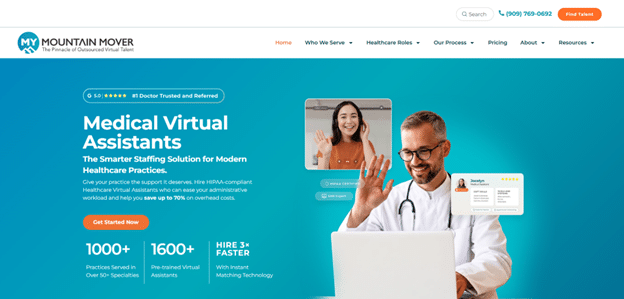
My Mountain Mover is a company that provides specialized virtual assistant services to the medical sector, organizing and protecting patient data to reduce costs. It signs and executes BAAs outlining responsibilities for practice management and PHI protection.
All medical virtual assistants are trained on leading EHR systems to ensure proficiency and optimize workflows. A guided onboarding process is provided for seamless setup and integration within your company, with regular check-ins and performance evaluations.
Its services have received a 5-star rating from over 600 clients thanks to their HIPAA compliance and their ability to save practices up to 70% on overhead costs.
DocVA
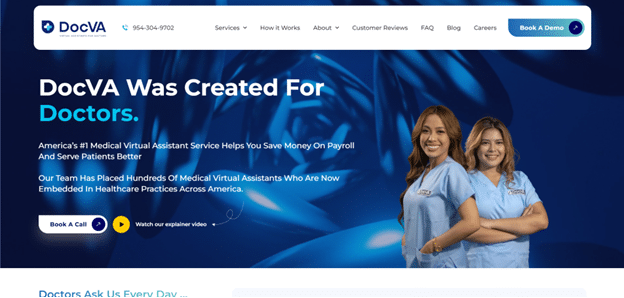
DocVA is another alternative that has provided healthcare practices with hundreds of dedicated virtual medical assistants. The company will sign a BAA as a safeguard for organizations handling protected health information.
It’s known for its transparent flat-rate pricing and ability to scale support for clinical workflows without having a lock-in period. Assistants are well-versed in many standard procedures like insurance verification and prior authorization, billing and administrative support, clinical documentation and more.
Certain specialties like primary care, internal medicine and more are supported alongside medical subspecialties and urgent care.
HelpSquad Health
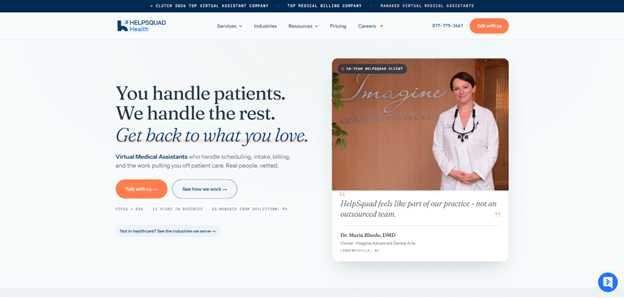
HelpSquad Health is a reliable managed service option that appeals to both small and large healthcare practices, whether they are surgical practices or dental service organizations. It ensures its VAs are covered by a company-level BAA.
It has reliable US-based account management with a strong focus on HIPAA compliance through secure virtual desktops. Companies can also utilize after-hours coverage and real-time medical scribing for utmost data accuracy.
Adding staffing is on your own terms and can be completed in as short as two weeks, with the team running consultation, role design and interviewing.
Frequently Asked Questions About Healthcare VAs and Data Security
Here are direct answers on commonly asked questions.
Do all healthcare virtual assistants sign a BAA?
While reputable healthcare-specific VA companies will offer BAAs, many generalist or overseas VA agencies may not offer them or lack the infrastructure to support them. It’s vital to explicitly request a BAA before granting a vendor access to PHI.
Who is liable if a virtual assistant breaches PHI?
Under HIPAA rules, the business associate is directly liable for protecting electronic PHI, which means they may face penalties for a breach. However, your organization can also face severe penalties if you failed to execute a BAA in the first place or ignored known security risks.
How do you verify a vendor’s HIPAA compliance?
Review the vendor’s standard BAA and ask for proof of comprehensive staff HIPAA training. Inquire about their technical safeguards and annual security risk assessments to ensure they maintain ongoing regulatory compliance.
Securing the Future of Your Practice
Protecting your patient data through a formal BAA is critical for maintaining compliance and avoiding costly penalties. Evaluate your current or future vendors and prioritize those who guarantee BAA compliance as a baseline requirement.
Those who do so can help mitigate administrative problems and continue the goal of helping others. Take action today to verify that every vendor handling PHI has executed a proper BAA with your organization.