
In This Article
This article contains:
- Screen At-Risk Patients Before Symptoms Appear
- Standardize FIB-4 Testing Across Everyday Workflow
- Build Clear Referral Pathways Across Primary Care, Endocrinology and Hepatology
- Separate Metabolic Liver Risk From Alcohol-Related Risk
- Equip Clinics With a Point-of-Care Liver Health Management Platform
- Frequently Asked Questions
Your clinic tracks blood sugar and blood pressure with precision, yet liver damage can slip through those same checkups unnoticed. Early-stage liver disease is typically asymptomatic and lacks observable clinical signs, making it challenging to identify, even within highly organized practices. Explore five approaches that primary care and endocrinology clinics use to facilitate early detection of hepatic changes and ensure timely patient care.
Metabolic dysfunction-associated steatotic liver disease (MASLD), previously termed nonalcoholic fatty liver disease (NAFLD), progresses insidiously. Development of cirrhosis may take over two decades, creating a prolonged window for early intervention.
NAFLD affects an estimated 24% of adults in the U.S. Integrating routine hepatic assessments alongside conventional kidney function and ophthalmologic screenings for diabetic patients can transform clinical practice from reactive to proactive.
The American Gastroenterological Association (AGA) identifies three high-risk groups for targeted liver screening:
- Adults with type 2 diabetes
- Adults who are overweight or obese with at least one more metabolic risk factor
- Patients with incidental liver steatosis on imaging or elevated liver enzymes
2. Standardize FIB-4 Testing Across Everyday Workflow
The Fibrosis-4 (FIB-4) index is a simple calculation that turns routine lab results into a fibrosis risk estimate. The AGA recommends a complete blood count and liver panel for at-risk individuals. These results are often already available in most clinical settings. Integrating the FIB-4 calculation directly into the electronic health record (EHR) streamlines workflow and eliminates the need for manual computation.
FIB-4 serves as the initial screening modality for fibrosis risk stratification. This quantitative measure assists clinicians in determining which patients require ongoing lifestyle management and which necessitate further diagnostic evaluation. Standardizing the use of FIB-4 across care sites supports consistency in clinical decision-making.
3. Build Clear Referral Pathways Across Primary Care, Endocrinology and Hepatology
Clear referral pathways are crucial for timely identification and management of patients at risk for advanced liver fibrosis due to MASLD.
For instance, patients with a FIB-4 score below 1.3 — or below 2.0 for those aged 65 and older — are considered to be at low risk and can remain in primary care, with repeat FIB-4 assessment recommended every 1 to 3 years. This approach safely rules out advanced fibrosis in the vast majority of cases, though approximately 10% of cases with advanced fibrosis may be missed.
If the FIB-4 score exceeds 1.3, or 2.0 in those over 65, the probability of advanced liver fibrosis increases. However, because specificity remains limited, particularly in populations with diabetes or older adults, further noninvasive evaluation is advised.
By integrating this stepwise, risk-based approach, primary care and endocrinology teams can efficiently triage patients, reserving hepatology referrals for those most in need and ensuring up-to-date, evidence-driven population health management.
4. Separate Metabolic Liver Risk From Alcohol-Related Risk
Conventional ultrasound demonstrates limitations in reliably identifying metabolic liver disease. In a study of 1,489 participants in China, standard ultrasound incorrectly classified 62.2% of non-MASLD cases compared with MRI-based hepatic fat quantification.
The AGA recommends systematic alcohol consumption screening using a validated three-question survey for all patients with metabolic risk. Given the elevated baseline risk within this group, clinicians are advised to proceed directly to fibrosis risk stratification without requiring ultrasound confirmation of steatosis. Combining alcohol screening with FIB-4 enhances identification of patients’ specific hepatic risk profiles.
5. Equip Clinics With a Point-of-Care Liver Health Management Platform
Laboratory-based risk estimates inform the next phase of evaluation, while point-of-care technologies enable immediate, in-clinic assessment. Selecting a liver health management platform that best aligns with institutional needs begins with a comparative review of noninvasive testing modalities designed for the clinical environment. Discover the best value liver health management solution for your clinic.
FibroScan® by Echosens
FibroScan® is the point-of-care platform Echosens developed, and the company positions it as the market leader, supported by over 5,384 publications. The platform measures liver stiffness without ultrasound components, a design that sets it apart from some competing systems. Echosens historically focused on hepatologists and now reaches gastroenterologists, endocrinologists and primary care physicians, so one platform may support your workflow as screening expands.
iLivTouch® by Hisky Medical

The iLivTouch® system from Hisky Medical combines vibration-controlled transient elastography with ultrasound imaging. Its ultrasound guidance helps operators locate the measurement area, and it reports both liver stiffness for fibrosis and ultrasound attenuation for steatosis. The company lists endocrinology and MASLD assessment among its clinical applications, and its wideband probe suits patients of different body sizes.
Velacur ONE by Sonic Incytes
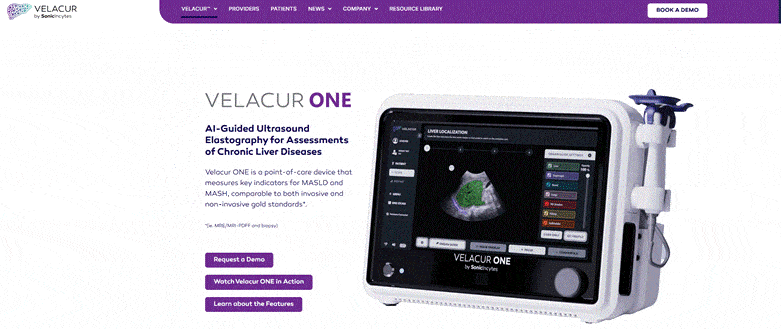
Velacur ONE by Sonic Incytes is a state-of-the-art ultrasound elastography device designed for clinics seeking an advanced liver health management solution. Featuring AI-guided technology, this tool offers real-time, 3D volumetric measurements of liver stiffness and fat, delivering accuracy comparable to MRI and biopsy, even in patients with high BMI. It can be used by any trained medical professional, offering clinics accurate, immediate results.
Frequently Asked Questions
Here are answers to commonly asked questions about liver health management solutions.
Which patients should your clinic screen for liver disease?
The AGA pathway focuses on adults with type 2 diabetes, adults who are overweight or obese with at least one more metabolic risk factor and patients with incidental liver steatosis on imaging or elevated liver enzymes. Because early disease rarely has noticeable signs, screening these groups before symptoms appear may help you catch changes sooner.
What is FIB-4?
FIB-4 is a simple calculation that uses routine lab results to estimate fibrosis risk. It serves as the first-tier screening step in the AGA pathway, and scores below 1.3, or below 2.0 for patients 65 and older, can generally be managed in primary care.
How is MASLD different from alcohol-related liver disease?
MASLD develops alongside metabolic risk factors such as type 2 diabetes and obesity, while alcohol-related liver disease stems from alcohol use. Because ultrasound has limited specificity for MASLD, pairing alcohol screening with FIB-4 may help you identify which risks apply to each patient.
Turn Today’s Blind Spot Into a Proactive Standard of Care
Closing gaps in metabolic liver management requires a systematic approach. Use targeted screening protocols for risk identification, integrate EHR tools for efficiency and establish clear referral pathways for specialist coordination. More importantly, employ validated point-of-care diagnostics for timely, accurate assessments. Regularly review and optimize your workflow to ensure you deliver the highest standard of liver care.