In This Article
This article contains:
- Same-Day Discharge Is Accelerating Faster Than Recovery Infrastructure
- Outpatient Rehab Remains Underused After Surgery
- Where Patients Land After Discharge Shapes Their Outcomes
- Partners Built to Carry Patients Through the Full Recovery Window
- Frequently Asked Questions
- Turning Recovery Data Into a Stronger Discharge Strategy
More surgical patients now go home the same day, shifting recovery into therapy clinics and living rooms beyond your view. Choosing outpatient therapy programs for post-surgery recovery has become a leadership decision that can shape functional outcomes, emergency department returns and episode-based payment performance. The partner you choose deserves service-line rigor.
Same-Day Discharge Is Accelerating Faster Than Recovery Infrastructure
Same-day discharge after joint replacement is becoming routine. By the fourth quarter of 2022, 23% of knee replacements among Medicare fee-for-service patients ended with the patient going home that day, as did about 16% of hip replacements and 36% of shoulder replacements. The shift looks structural, so more recovery now unfolds after patients leave your building.
Federal policy is following that shift. Under the Transforming Episode Accountability Model (TEAM) from the Centers for Medicare & Medicaid Services (CMS), selected hospitals are accountable for 30 days post-discharge across five surgical categories, including episodes that begin with a hospital outpatient procedure. If your hospital participates, therapy referrals become financial decisions as well as clinical handoffs.
Participating hospitals carry 30-day cost and quality risk, including avoidable readmissions and emergency department visits, across these categories:
- Joint replacement: Lower-extremity joint replacement is the category most closely associated with orthopedic therapy referrals.
- Hip and femur fractures: Surgical treatment of these fractures also starts an episode.
- Cardiac bypass: Coronary artery bypass graft surgery falls within the model.
- Spinal fusion: Spine procedures carry the same 30-day window.
- Bowel surgery: Major bowel procedures complete the list.
TEAM applies only in selected markets and runs from January 1, 2026, through December 31, 2030. CMS lists 716 participating hospitals so far. Its underlying logic, which is accountability beyond the hospital door, reflects where value-based payment is heading. If you own the 30 days, the next question is whether patients receive the rehab that shapes recovery.
Outpatient Rehab Remains Underused After Surgery
Outpatient rehab still plays a small role in early recovery. In Texas, it was the first post-acute setting for fewer than 9% of Medicare patients after knee replacement in 2018, with the share rising only from 7.36% in 2016 to 8.60%.
A prescription alone may not secure attendance. In a 2024 orthopedic clinic study, 40 of 100 patients never attended prescribed physical therapy (PT). Postoperative patients were more likely to attend than those prescribed PT as first-line treatment, making each post-surgical dropout a coordination gap worth closing.
Among the 40 patients who skipped therapy, four solvable barriers stood out:
- Time constraints: Fourteen patients named time as the obstacle, the most common reason given.
- Self-directed care: Eleven patients chose to manage therapy on their own at home.
- Cost and coverage: Three patients pointed to co-pays or insurance.
- Transportation: Two patients had difficulty getting to appointments.
Demand adds pressure. The Bureau of Labor Statistics expects physical therapist employment to grow 12% from 2025 to 2035, with 13,400 openings projected each year. That may strengthen the case for established partners over building capacity alone.
Where Patients Land After Discharge Shapes Their Outcomes
The right recovery setting varies by patient, and two lines of research help frame that decision:
- Home discharge: A propensity-matched study of 5,000 knee replacement patients per cohort found lower readmissions after home discharge and fewer adverse events than discharge to inpatient rehab or skilled nursing facilities. The finding supports matching setting to need, since patients who require intensive inpatient rehab remain a distinct group.
- Telerehabilitation: A 2024 meta-analysis of 25 randomized trials involving 4,402 patients found telerehabilitation more effective than face-to-face rehab after knee replacement. Hybrid or virtual options may ease time and travel barriers. Because results varied by outcome, remote care may work best alongside in-person therapy.
The therapy environment also deserves scrutiny. A 2024 review in the Health Environments Research & Design Journal (HERD) found rehab spaces are often outdated and undersized, with limited design guidance. It linked privacy, social interaction, enriched surroundings, accessibility, and wayfinding to confidence and motivation. The evidence is still emerging, but the setting merits evaluation.
Partners Built to Carry Patients Through the Full Recovery Window
Outpatient therapy programs differ in care continuity, referral coordination and patient experience. The three organizations below represent distinct models to weigh against those needs.
1. PAM Health Continues Recovery From Hospital to Home
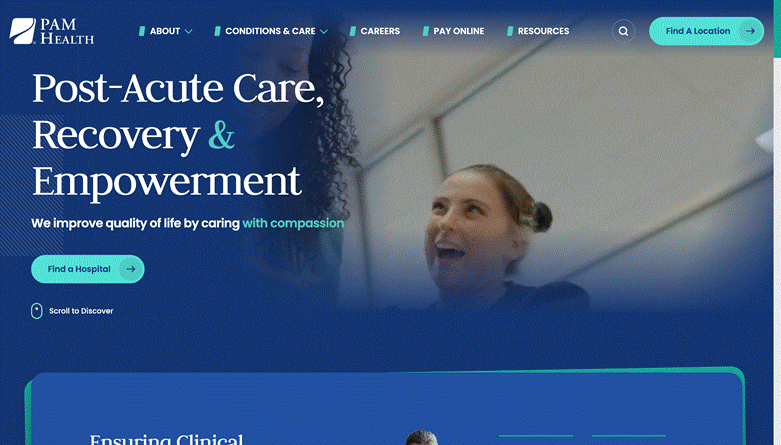
PAM Health reports more than 70 hospitals and over 50,000 patients treated each year. Its outpatient rehabilitation services cover orthopedic conditions and recovery after surgery, with physical, occupational and speech therapy available. A licensed therapist assesses each patient, while care coordinators help shape the plan.
That structure may be useful for case managers and physicians focused on continuity, readmission risk and the patient experience after discharge. PAM Health also emphasizes the care environment. A former specialty hospital patient compared admission to checking in at a hotel and described an atmosphere more relaxed than a typical hospital, while several pages list a tour option.
2. Upstream Rehabilitation Offers Multi-Brand Outpatient Access

Upstream Rehabilitation reports more than 1,200 outpatient clinics in 28 states, more than 8,000 associates and more than 8 million patient visits each year. Its network centers on outpatient physical therapy, with occupational and hand therapists also part of its clinical teams across regional brands.
For health systems with employed physician groups or outpatient access needs, the company’s physical therapy management services may also be relevant. Its locally branded clinics may give people a familiar neighborhood option for ongoing visits close to home, while the company frames its goals around less pain and better mobility.
3. Athletico Physical Therapy Extends Outpatient Coverage

Athletico Physical Therapy reports roughly 900 locations in 24 states and Washington, D.C., more than 30 years in operation and more than 50 specialty services. Its services include outpatient physical therapy, occupational and hand therapy, home therapy and a home exercise app, which may help address time and travel barriers that affect attendance.
The company offers free assessments without a prescription in many states and accepts most major insurance plans. Athletico also reports that 98% of patients would recommend it, though its listed partnerships center on sports teams, schools and employers, which may mean less visible health system experience.
Frequently Asked Questions
Leaders evaluating outpatient therapy partners often focus on accountability, selection criteria and care settings.
How does the TEAM model affect outpatient therapy partner decisions?
Participating hospitals are accountable for cost and quality from surgery through 30 days after discharge. That makes therapy access and attendance part of both patient outcomes and episode cost. A partner that helps patients show up and progress may therefore support stronger results under the model.
What criteria matter most when vetting a post-surgery therapy partner?
Four criteria stand out — continuity from inpatient to outpatient care, attendance support through flexible scheduling and hybrid options, capacity in a high-demand workforce, and a high-quality care environment.
Does a rehab facility’s physical environment affect recovery?
Emerging research suggests it may. A balance of privacy and social interaction appears to support patient confidence and motivation, and enriched, accessible spaces may matter too. Because the evidence is still developing, treat the environment as one factor among several when you evaluate partners.
Turning Recovery Data Into a Stronger Discharge Strategy
Recovery responsibility now extends beyond the operating room, and the 30 days after discharge are where outcomes and costs take shape. Underused rehab and missed appointments create a gap that scheduling, hybrid options and coordination may narrow.
Matching setting, format and environment to each patient is part of quality care. The right partner extends your system’s standard of care beyond its own walls, and your discharge strategy is only as strong as the care that follows it.