In This Article
This article contains:
- Aligning Evaluation Criteria With Clinical and Operational Workflows
- Prioritizing Interoperability Across Your Network
- Vetting Vendors for Security and Compliance Readiness
- Building a Structured, Multistakeholder Evaluation Process
- Partnering With an Established Diagnostic Software Provider
- Frequently Asked Questions
- Making Diagnostic Technology Decisions With Confidence
A single misstep in diagnostic software selection can disrupt patient care, invite compliance scrutiny and strain budgets across every site in your network. Learn from the best practices of prudent senior executives to evaluate and choose the right solutions for health systems across global networks.
Aligning Evaluation Criteria With Clinical and Operational Workflows
Workflow misalignment ranks among the costliest mistakes in diagnostic technology adoption, often forcing staff to adapt to a tool rather than the other way around. Assess whether a system fits your existing workflows before comparing vendors.
Digital tools with efficient user experience integrate more smoothly into clinical workflows, while well-designed lab integrations help patients coordinate blood work and understand results. Weigh these factors as you compare systems:
- Usability: An intuitive interface reduces training time and limits errors.
- Integration: Software that connects cleanly with existing records keeps data centralized.
- Scalability: Look for a platform built to grow with patient volumes, so it does not need a costly rebuild.
Prioritizing Interoperability Across Your Network
Multisite and global health systems face a distinct challenge, as patient data generated at one facility must remain accessible at every other location. Prioritize vendors whose tools support standardized data exchange, so results move seamlessly between sites.
Established by the Office of the National Coordinator for Health Information Technology, the Trusted Exchange Framework and Common Agreement provide a nationwide interoperability framework in the United States. It sets a universal floor for data sharing, allowing key stakeholders to securely access health information, regardless of where it is stored.
Vetting Vendors for Security and Compliance Readiness
Every diagnostic technology decision carries compliance risk alongside its operational upside. Any vendor handling patient data becomes part of your compliance surface, so vet its security posture before adoption, not after.
The Health Insurance Portability and Accountability Act (HIPAA) Security Rule’s risk analysis requirement directs covered entities to assess the risks and vulnerabilities to electronic protected health information, a mandate that extends to outside partners too. Treat it as a floor, not a checkbox, since gaps surface only after a breach.
Building a Structured, Multistakeholder Evaluation Process
No single department should own a major technology decision alone, since clinical, financial and compliance consequences all flow from the same choice. A structured process involving multiple stakeholders, led by one accountable owner, works best.
When adopting software with features powered by artificial intelligence, forward-thinking business leaders in healthcare gravitate toward an adaptable governance framework consisting of these vital components:
- Strategic alignment: Tools should support broader priorities.
- Executive sponsorship: Senior leadership should champion the solution and guide integration.
- Multistakeholder risk assessment: Clinical, IT, finance and compliance leaders should weigh in before signing.
- Projected impact and value: Measuring expected outcomes against the investment required is necessary.
Partnering With an Established Diagnostic Software Provider
After setting clear evaluation criteria, health system leaders seek vendors equipped to meet them. The solutions of these companies demonstrate what healthcare system decision-makers need.
1. Danaher

Danaher is an influential brand in the scientific industry whose diagnostic software solutions are highly rated by healthcare executives globally. Headquartered in Washington, D.C., it operates more than 15 businesses within a unified system.
The company has a wide range of software solutions under its umbrella, such as DxONE by Beckman Coulter, a piece of cloud-based middleware connecting analyzers to a lab’s IT systems, with one control point managing up to 18 instruments.
Radiometer’s AQURE is another example. Labs use this vendor-neutral middleware to manage point-of-care devices while staying accreditation-ready. Meanwhile, Aperio HALO AP by Leica Biosystems is a pathology image-management system that includes an embedded library of AI applications.
2. Agilent
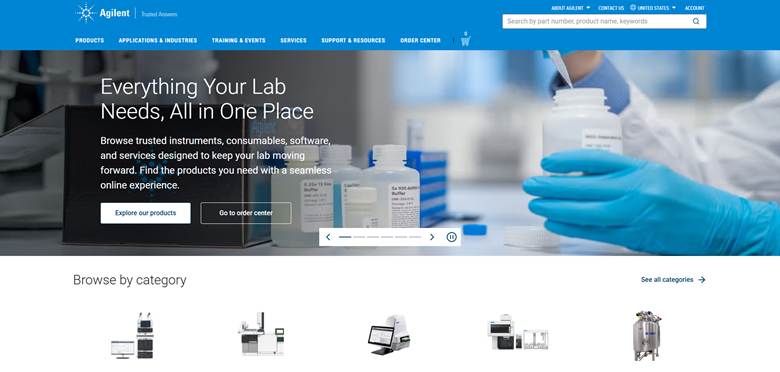
Agilent is a diagnostic software developer and lab instrument manufacturer based in Santa Clara, California. Its portfolio spans chromatography data management, instrument diagnostics and AI-powered imaging tools for high-volume laboratories.
Health systems operating across multiple sites use OpenLab software suite to manage chromatography and mass spectrometry data alongside lab workflows, with cloud deployment available.
Moreover, the company’s Lab Advisor tracks instrument health and sends maintenance alerts before small issues become costly downtime. Its BioTek Gen5 software has built-in AI, powering its cell identification along with imaging and microscopy analysis.
3. Thermo Fisher Scientific

Thermo Fisher Scientific offers a broad suite of laboratory information and quality management software for clinical labs operating under strict regulatory requirements. This multinational corporation’s global headquarters is in Waltham, Massachusetts.
SampleManager LIMS and Core LIMS are laboratory information management systems that automate workflows and help labs meet strict regulatory requirements.
The company’s quality assurance and control software solutions, LabLink 360 and LabLink xL, monitor performance and analyze Sigma metrics in clinical laboratories. The Connect Platform is a workflow solution that brings together lab automation and data management.
Frequently Asked Questions
Senior executives in healthcare systems often ask these questions when assessing diagnostic software and lab technology solutions across international networks.
What criteria should health system leaders prioritize when evaluating diagnostic software?
The criteria health system leaders should prioritize when evaluating diagnostic software are usability, integration and scalability. They guide decision-makers to choose solutions that are intuitive enough to require less training and reduce errors, connect seamlessly with other systems and can grow with the organization.
Why does interoperability matter when adopting lab technology across multiple locations?
Interoperability matters when adopting lab technology across multiple locations because data must be accessible by key stakeholders, regardless of the facility that generated it.
Who should be involved in the vendor selection process for new diagnostic technology?
Clinical, IT, finance and compliance leaders should be involved in the vendor selection process for new diagnostic technology. One accountable senior executive should lead the way and champion the solution from selection through adoption and continuous use.
Making Diagnostic Technology Decisions With Confidence
Adopting diagnostic software and laboratory innovations is a major decision. By aligning workflows, prioritizing interoperability, vetting compliance and building structured processes, you can address your organization’s technology needs with confidence.