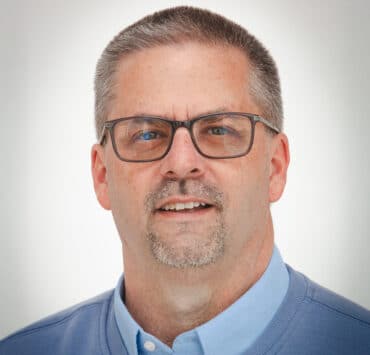
Whenever Gordon Groschl has the chance, he eats lunch in the cafeteria at Texas Children’s Hospital. As chief information security officer (CISO) and director of healthcare technology management, Groschl isn’t interacting with patients. His job is to make sure that technology connected with Texas Children’s is supporting the hospital’s mission of saving young lives. But by sitting down in the cafeteria for a few minutes, any potential disconnect he may ever feel quickly vanishes.
“We are impacting the lives of the most vulnerable people every single day,” Groschl says. “The patients we serve are often very, very sick kids, and all you have to do is look around to remember why, in my case, I’ve been here close to twenty years.”
Groschl didn’t plan on staying for so long when he joined Texas Children’s in 2006. The future CISO initially joined as a project manager and application architect. Groschl came from telecom, where metrics like subscriber numbers and cost optimization reigned supreme. But the IT leader knew what it meant to serve a larger mission, having served in the Austrian military, in his country of birth.
Coming to a nonprofit healthcare environment was a welcome shift, but Groschl still didn’t think he’d be with the same organization for a couple of decades. The connection he felt to the women and children his organization serves, as well as Texas Children’s nonprofit status, refined his sense of professional purpose, and kept him growing into new roles and challenges.
Groschl’s present role puts him at the forefront of protecting the organization’s data and digital services. Over the last year, the CISO has also assumed leadership of the healthcare technology management (HTM) team, which oversees the hospital’s biomedical devices, some sixty-five thousand individual pieces of tech. The increased responsibility added around seventy new members to Groschl’s oversight, and required the leader to bridge the worlds of cybersecurity and biomedical engineering, a convergence that speaks to the increasing digitization of healthcare tech.
More so, in the past decade, the pace of change has accelerated. Most new medical devices are now network-connected computers with all of the attendant cybersecurity risks included.
AI has added further complexity to Groschl’s responsibilities. The CISO is leading efforts to adopt AI ethically and securely, investing in controls and governance structures that allow Texas Children’s to leverage AI for improved patient care, while mitigating associated risks.
Groschl’s team has invested in frameworks for the ethical and secure adoption of AI, utilizing best practices recommended by the National Institute of Standards and Technology (NIST) and the Health Sector Coordinating Council (HSCC). By implementing technical and administrative controls around AI, Texas Children’s aims to harness the benefits of automation and data-driven insights while safeguarding patient privacy and system integrity.
For any tech leader, risk is ever-present. The healthcare sector is under constant threat from cyberattacks, and recent high-profile incidents continue to underscore the need for recovery and resilience planning.
“We are impacting the lives of the most vulnerable people every single day. The patients we serve are often very, very sick kids, and all you have to do is look around to remember why, in my case, I’ve been here close to twenty years.”
Gordon Groschl
The CISO and his team continue to invest in technologies and processes that enhance the hospital’s ability to withstand and quickly recover from cyber incidents.
Groschl is a dedicated cybersecurity professional, taking time outside of his role to participate in the broader cybersecurity community. He participates in industry groups, panel discussions, and the Children’s Hospital Association’s cybersecurity group.
“I’m a big believer in community learning,” Groschl says. “While we are all in unique organizations, fundamentally, we’re cooking with the same water. We’re going to have similar problems. By sharing our struggles and our successes, we’re able to more effectively run our programs.”
The CISO owes a great debt to his early mentors for guiding his leadership. Groschl credits them with shaping his management style, one he pays forward today by actively mentoring both his direct reports and aspiring cybersecurity professionals in his community. Given the talent shortage of cybersecurity personnel, that mentorship is all the more crucial.
Going forward, Groschl’s concerns remain what they have been, but that’s the nature of cybersecurity and HTM: the same fundamental idea played out in exponentially and increasingly complicated ways. The CISO and his team continue to double down on resilience and ethical AI implementation. Groschl is on the frontlines of ensuring that Texas Children’s can spend all of its time on its patients, and as little time on anything else. That’s the mission Groschl came to support, and it’s kept him here for twenty years.
Converge is a global IT and cloud solutions provider transforming how businesses leverage technology. By blending regional expertise with global resources, we deliver tailored, people-centered solutions that drive efficiency, enhance security, and unlock the power of AI and data insights. Guided by our proven AIM methodology (Advise, Implement, Manage), we focus on measurable outcomes to help businesses modernize and thrive in the face of tomorrow’s challenges. At Converge, we believe technology is more than a tool; it’s a catalyst for innovation, progress, and limitless potential. Together, we simplify complexity and empower teams worldwide to grow and succeed.
Healthcare organizations use a diverse set of IT infrastructure spanning OS platforms, servers, user endpoints, cloud, and IoT.
The SentinelOne Singularity XDR Platform combines next-gen prevention and EDR capabilities to achieve autonomous Endpoint Protection at machine speed. AI monitors thousands of concurrent OS processes across every endpoint, every millisecond of every day, to detect malicious behavior. SentinelOne aims to provide more capability and less complexity. We are pioneering the future of cybersecurity with autonomous, distributed endpoint intelligence aimed at simplifying the security stack without forgoing enterprise capabilities. SentinelOne is honored to collaborate with Texas Children’s Hospital to enhance their cybersecurity capabilities.